Introduction to genetic algorithms
Genetic algorithms (GA) are one of the many optimization methods. The idea is based on Darwin’s evolution principle and random/stochastic processes. Genetic algorithms work with the population of solutions which are called chromosomes. In every chromosome is an encoded solution for a given problem. For every chromosome is a calculated fitness value, which quantifies how suitable a solution (chromosome) is. Using the semi-random process of selection, together with other genetic operators like crossover and mutation, gives chromosomes a chance to reproduce. This initial population then creates a new population and this ends one generation cycle.
One of the key components is that chromosomes which encode better solutions (with better fitness values) have a higher chance of being selected for reproduction. After many generation cycles, this makes a difference as information from better solutions is more likely to survive or improve the next generation cycle.
With genetic algorithms, we cannot guarantee finding optimal solution, but we can find a suitable solution in an acceptable time.
Terminology
Structure
Genetic algorithms have following structure:

Genetic algorithms structure
Encoding
Encoding determines the possible values for each gene in a chromosome. Selecting the correct encoding is one of the challenges in GA and it is one of the most common mistakes.
In GeneticAlgos, the encoding type is configured with the gene_interval parameter which has type
numpy.ndarray.
Binary encoding
The simplest form of encoding is binary encoding. Each gene can have two values - 0 or 1.

Binary encoded 9 gene chromosome
GeneticAlgos supports binary encoding and can be configured very easily. We have to specify the
range [0, 2] (0 is inclusive and 2 is exclusive) for each gene and the length of the chromosome.
Below is an example of how we can configure binary encoding for our model. We also have to
configure chromosome_type=int.
import geneticalgos as ga
import numpy as np

# Binary encoding chromosome with 9 genes
binary_chromosome = np.array([[0, 2]] * 9)

ga_model = ga.GeneticAlgo(
    fitness_function=sum,
    gene_intervals=binary_chromosome,
    chromosome_type="int"
)
Numerical encoding
In numerical encoding, genes have numerical values.
GeneticAlgos supports float and integer numerical encoding. The default value is float.

Integer encoding with gene intervals [0, 5]

Float encoding with gene intervals [0, 5]
Below is an example for integer numerical encoding and every gene can have values 0, 1, 2, 3, 4.
import geneticalgos as ga
import numpy as np

# Numerical encoding with gene values 0, 1, 2, 3, 4 and chromosome length 9
numerical_chromosome = np.array([[0, 5]] * 9)

ga_model = ga.GeneticAlgo(
    fitness_function=sum,
    gene_intervals=numerical_chromosome,
    chromosome_type="int"
)
Parameter gene_interval can have a different range of values for every gene. Below is a model with a chromosome which has 3 genes with different ranges. Gene 0 binary gene, gene 1 int values from 5 to 9, gene 3 float values from 2 to 7.
ga_model = ga.GeneticAlgo(
    fitness_function=sum,
    gene_intervals=np.array([[0, 2], [5, 10], [2, 8]]),
    chromosome_type="int"
)
Fitness function
Fitness function is used to evaluate the solution and return the numerical value which represents the suitability of the given solution. It can be specific for each problem. In many cases, creating the good fitness function is the biggest challenge, especially in cases where the solution has to adjust according to many criteria.
In GeneticAlgos, it is mandatory that user creates a fitness function for their model. So far, we
have just used trivial fitness functions as a built-in sum function. Below is an example of a fitness
function which is trying to find an optimal set of weights (w1, w2, w3, w4, w5) for maximizing function
f(x) = 4w1 - 5w2 + 8w3 - 11w4 + 3w5. Weights are float numbers from 0 to 10. Fitness function
takes chromosome as an argument.
from geneticalgos import ga
import numpy as np

def custom_fitness_function(chromosome):
    # equation 4w1 - 5w2 + 8w3 - 11w4 + 3w5
    function_constants = [4, -5, 8, -11, 3]
    return sum(x * y for x, y in zip(chromosome, function_constants))

ga_model = ga.GeneticAlgo(
    fitness_function=custom_fitness_function,
    gene_intervals=np.array([[0, 5]] * 5),
)
Selection
The goal of selection is to choose chromosomes from the population for reproduction (crossover, mutation). Selected chromosomes are called parents. Selection has to mimic natural processes, where stronger individuals have a higher chance of being chosen for reproduction. Then we can expect that offspring created from quality parents have even better parameters and more suitable fitness values. On the other hand, selection must preserve diversity and cannot hold too much of a preference for only a couple of strong individuals.
When selection prefers only a small subset of strong (better fitness value) individuals, then they can very quickly control a whole population. This will dramatically decrease diversity in a population and it can lead to that population converging to a local optimum.
When a selection process is very loose and there is not enough pressure to choose stronger individuals, then the evolution process is very slow. There can be many generation cycles without any improvement.
There are 4 types of selection mechanisms implemented in GeneticAlgos. Each of them has pros and cons.
1) Fitness proportionate selection, also known as roulette wheel selection. A chromosome’s chances of being selected are proportionate to the fitness values of each chromosome and the differences between them. An advantage is that significantly better solutions have a higher probability of being chosen, and this can speed up evolution. On the other hand, we are losing diversity quite quickly in favor of superior individuals and this can lead to early convergence to a local optimum. This type of selection is helpful in the beginning of the evolution process as it rules out non-useful chromosomes.
ga_model.selection_type = "roulette_fitness"
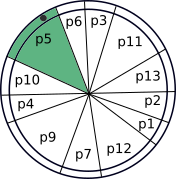
p(i) - probability of selection for chromosome (i)
2) Rank selection uses the rank from the best to the worst chromosome based on fitness value to determine the probability of a given chromosome being chosen. Two neighboring rank positions have a relatively small difference in probability regarding their fitness. This method still prefers better solutions, but not as much as fitness proportionate selection, which is advantageous in the later phases of the evolution. On the other hand, rank selection converges more slowly because there is not as much pressure for preferring superior solutions as in fitness proportionate selection.
ga_model.selection_type = "roulette_rank"

R(i) - chromosome rank, R1 - best, …, R10 - worst
3) Tournament selection randomly selects k number of chromosomes and chooses the best out of these
to become a parent. The default value for k in GeneticAlgos is 3. The higher the k value,
the more they are deemed superior chromosomes. A lower k value means more diversity.
ga_model.selection_type = "tournament"
ga_model.selection_k = 3
4) Random selection is the default selection type in GeneticAlgos. Every generation cycle randomly chooses one selection method from: fitness proportionate selection, rank selection, and tournament. The advantage of this is that it uses different selection methods in a random fashion, utilizing each of their respective pros. Each phase of the evolution has different requirements and random selection meets them in the best way for a lot of cases.
ga_model.selection_type = "random"
Crossover
Crossover is a fundamental genetic operator between two selected parents. Parents exchange genes to create new individuals (offspring). Therefore, offspring chromosomes have genes from both parents.
There are 4 types of crossover implemented in GeneticAlgos.
1) One-point randomly picks one crossover point in chromosomes. Genes to the right of that point are swapped between the two parent chromosomes. This results in two offspring, each carrying some genetic information from both parents.
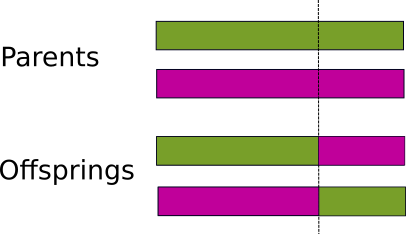
One-point crossover
One-point crossover can be configured with the following command:
ga_model.crossover_type = "one_point"
2) Two-points randomly picks two crossover points. The genes in-between the two points are swapped between the parent organisms.

Two-points crossover
Two-points crossover can be configured with the following command:
ga_model.crossover_type = "two_points"
3) Uniform crossover treats each gene separately. Both parents have a 50% chance of their gene ending up in their offspring. Some researchers consider uniform crossover the most powerful method because it allows the offspring chromosomes to search all possibilities of recombining those different genes in parents.

Uniform crossover
Uniform crossover can be configured with the following command:
ga_model.crossover_type = "uniform"
4) Random crossover randomly chooses a crossover type in each generation cycle. It is the default crossover method.
ga_model.crossover_type = "random"
Crossover probability specifies how likely is that crossover is applied to selected parents.
GeneticAlgos has a default crossover_prob of 90%. It means there is 90% chance that crossover
is applied to the given parent pair.
We can easily change crossover probability to a different value:
ga_model.crossover_prob = 0.8
Mutation
Mutation is a genetic operator which alters one or more gene values in a chromosome from its initial value. Advantage is that it maintains genetic diversity from one generation to the next.
GeneticAlgos uses random mutation. When a gene is selected for mutation, it changes value to any random value from the gene_interval range.

Mutation
In GeneticAlgos, mutation is applied to each gene with mutation probability. The default value is 20%, meaning there is 20% chance that gene is going to mutate. Increasing mutation probability brings more diversity, but when it is too high it can be disruptive and lead to losing original gene information.
We can change mutation probability:
ga_model.mutation_prob = 0.3
Creating new population
In traditional implementation of the genetic algorithms when genetic operators create offspring,
they replace the parents of the new population. In GeneticAlgos, this type of new population is called
always_offsprings. One disadvantage is that sometimes we might lose quality individuals when
genetic reproduction creates less suitable offspring. However, an advantage is that there is
increased diversity from one generation to next.
ga_model.new_pop_type = "always_offsprings"
It might happen that even two quality fitness parents produce less suitable offspring (with a worse
fitness value than their parents). For this reason, there is the tournament new population type
which is implemented in GeneticAlgos. It selects the two best chromosomes amongst parents and offspring.
The main disadvantage of the tournament type is that when a single superior chromosome is selected
to be a parent to more reproduction pairs, it can lead to a situation where this individual controls
the population.
ga_model.new_pop_type = "tournament"
The default value for a new population type in GeneticAlgos is random which randomly selects a new
population type between always_offsprings or tournament.
Another variant of constructing new population is Elitism. Elitism allows the best individuals to be carried over to the next generation without any gene change. This method guarantees that the solution quality obtained by the genetic algorithms will not decrease from one generation to the next.
GeneticAlgos has implemented elitism and by default, the best 2 solutions are carried over to next generation.
The number of elite solutions can be configured with n_elite parameter. If n_elite is equal
to 0, there is no elitism applied to evolution.
ga_model.n_elite = 5
Hint
When the number of n_elite + (2 * n_pairs) is greater than population_size then ValueError is raised with guidance to which interval is allowed for n_elite.